Pages

HTC 'Volantis' Tablet

Sunday, 6 July 2014
htc_one_m8_front_camera_bezel_official.jpg
The alleged HTC 'Volantis', purportedly the next Nexus tablet, has leaked online again, this time in a blurry image accompanied by purported specifications.
Serial tipster, @evleaks, has posted some of the specifications HTC 'Volantis' along with a macro shot of the alleged tablet that shows the rear panel. However, GSM Arena claims that the leaked image is a fake one.
@evleaks also claims that the 'Volantis' will feature an 8.9-inch (2560x1600 pixels) WQXGA display; 5GB DDR3 RAM; 64GB inbuilt storage; 5- or 8-megapixel camera with full-HD recording. In-line with earlier leaks, the alleged HTC Volantis is said to powered by a 64-bit Tegra K1 processor.
However, the serial tipster notes that the RAM value is not final and might change at launch. Further, the HTC-made tablet codenamed Volantis will sport the BoomSound feature, also seen in HTC's flagship devices.
Earlier, a report claimed that the alleged HTC Volantis will see light of the day in Q4 2014 and would be priced at $399 for the 16GB version, and $499 for the 32GB version.
Further, a leaked image of the rumoured Volantis tablet was leaked and appeared to be cross between the LG's Nexus 5 and Asus' Nexus 7 (2013) tablet.
Reports for a while have been indicating that Google's next Nexus tablet could be introduced with Android's newer version and KitKat's successor, the L build of Android, which was unveiled at I/O 2014.
Read more ...

Xolo Launches Play 6X-1000 and Q500s IPS With Android 4.4 KitKat

Sunday, 6 July 2014
xolo_q500s_ips.jpg
Xolo has launched two new smartphones, the Q500s IPS and Play 6X-1000, which have been priced at Rs. 5,999 and Rs. 14,499 respectively. Both the smartphones run Android 4.4 KitKat out-of-the-box, and have been listed as new arrivals on the company's site.

Read more ...

Wickedleak Wammy Neo

Sunday, 6 July 2014
wickedleak_wammy_neo_cover_ndtv.jpg
The budget smartphone race in India is getting hotter by the day. It is increasingly becoming difficult to weed out the best from the rest. The entry of smaller, unknown brands might not seem to be any threat to established companies, but anyone could potentially disrupt the market with an attention-grabbing new product. Isn't this how Micromax rose to fame?
Read more ...

Bose SoundTrue On-ear

Sunday, 6 July 2014
Bose_SoundTruemain.jpg
Bose might be one of the best known names in audio equipment, but these days when you look at headphones, you see popular brands such as Beats and Skullcandy beginning to displace it in the high-end space. We tried out the Bose SoundTrue on-ear headphones, which feel like a response to this trend. The headphones have a sleek design and good sound, but at a price of Rs. 13,388, the question most people will ask is, "are these worth the money?" Read on to find out more:

Read more ...

WD My Cloud

Friday, 4 July 2014


The term "cloud" has been used and abused to the point where it really encompasses anything that's connected to the Internet. WD is also somewhat guilty of misusing the term by calling its latest network-attached drive My Cloud, since it's nothing of the sort. Sure, you can connect it to the Internet and access your files from pretty much anywhere on the planet - which is nothing new - but you're also giving up some of the best advantages of hosted services. Read on to find out what we think of the product.

Read more ...

Air Force Bugbots

Thursday, 3 July 2014

It’s a hot summer day and you’re enjoying a family barbeque in the backyard when a small yet annoying bug enters your field of vision, it gently lands on your forearm and just before you are about to squash it, you notice a tiny flashing light. As you begin to scrutinize this strange insect you suddenly realize the awful truth, it’s not a bug at all, it's a “bugbot” and someone is watching you.

Read more ...

Parrot Bebop Drone

Thursday, 3 July 2014
Parrot has been making automated flying drones for a while. The first of them was the AR.Drone. While at least one person has hacked their AR.Drone to be controlled using an Oculus Rift, Parrot has unveiled that it’s next drone – dubbed the Bebop – will offer optional Oculus Rift support.
Using that VR headset, and the optional Parrot Skycontroller, users can have an immersive view of what the drone’s camera sees as it flies. The Bebop’s fixed camera is a 14MP unit with a fisheye lens that can shoot 1080p video. The camera also has a robust image stabilization system, and its software lets you zoom in and move around the image, rather than using a motorized gimbal like other competing quadrotors. The Bebop also has GPS support and can be programmed to fly between waypoints autonomously, and return home when done.

Read more: http://technabob.com/blog/2014/05/12/parrot-bebop-drone/#ixzz36QTD6LXa 

Read more ...

Samsung Galaxy Tab S 8.4

Thursday, 3 July 2014
Samsung Galaxy Tab S 8.4

1. The two colour options of the Samsung Galaxy Tab S 8.4 include Dazzling White and Titanium Bronze. It was launched in India alongside the Galaxy Tab S 10.5, which has the same specifications but a larger display.


Samsung Galaxy Tab S 8.4

2. The Samsung Galaxy Tab S 8.4 runs Android 4.4.2 Kitkat.


Samsung Galaxy Tab S 8.4


3. The Samsung Galaxy Tab S 8.4 is powered by an octa-core Exynos 5 SoC (quad-core 1.9GHz Cortex-A15 and quad-core 1.3GHz Cortex-A7) processor coupled with 3GB of RAM.


Samsung Galaxy Tab S 8.4

4. Samsung Galaxy Tab S 8.4 with 8.4-inch screen offers a resolution of 2560x1600 pixels and boasts of an impressive 359ppi pixel density.


Read more ...

Samsung Galaxy K zoom

Thursday, 3 July 2014
samsung_galaxy_k_zoom_blue.jpg

The camera-variant of the Samsung Galaxy S5, the Galaxy K zoom, has been launched in India, and is now up for pre-order exclusively on Amazon India at Rs. 29,999. The latest Samsung camera phone's pre-orders started midnight on Wednesday, and will be available for delivery from July 9.
The Internet retailer has also announced some of the launch offers for the first 1000 customers pre-booking the Galaxy K zoom, which will get Rs. 6,000 worth of offers. These offers include free Samsung Pop out case; Sandisk 32GB microSD card; six free movie tickets; Rs. 1,000 value off coupon on purchase of select handbags on Amazon India; Rs. 1,000 value off coupon on purchase of select watches. Earlier this week, Amazon India had teased the Galaxy K zoom launch.
Initially announced in April, the Galaxy K zoom is the second camera-specialised smartphone from the company, the first being the Galaxy S4 Zoom.
Notably, the Samsung Galaxy S4 Zoom launched in India on July 9 last year, the same day which will see the Galaxy K zoom get availability in India this year. The Galaxy S4 Zoom (Review | Pictures) was launched at Rs. 29,900.
The Galaxy K zoom sports a 20.7-megapixel BSI CMOS sensor at the back accompanied by a Xenon flash and also features optical image stabilizer (OIS) for low-light imaging. The rear camera supports 10x optical zoom. The rear camera comes with some advanced camera usability features and functions, including AF/AE Separation (/Auto Focus/ Auto Exposure Separation); Pro Suggest mode that offers 5 optimized filter settings, Selfie Alarm offers users to take timed selfies. The Galaxy K zoom also houses a 2-megapixel front-facing camera.
Read more ...

Smarty Rings

Wednesday, 2 July 2014
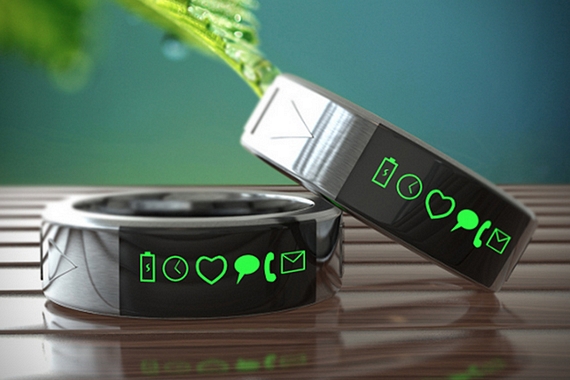
The rising popularity of smartwatches confirms one thing: a good amount of people are stoked about the idea of wearing computers on their limbs.  Since we have that "wearable computer on the wrist" part figured out, it's probably time to move on to other body parts.  How about those skinny things sticking out of your hands?  Well, the Smarty Ring wants to take care of that.
Why use a gadget that wraps around the wrist for mobile notifications when you can have all those on a gadget that's worn on just a single finger?  Yeah, makes sense to me.  Sure, a ring is too small to read emails, hold a camera, or cram in a mic for hands-free conversations, but if all you plan to use a smartwatch for are receiving notifications, then this seems like a more efficient device for achieving the same thing.
The Smarty Ring is a stainless steel band with a small LED panel (single-color only, either blue or red) on the body acting as the display.  The panel will display time by default (you can set the time from the accompanying app), but will change to display an icon, along with playing an audible beeping sound, when a notification comes in.  It uses Bluetooth 4.0 to pair with your phone, after which it can alert you of calls, texts, emails, and various updates (upon launch, Facebook, Twitter, Google Hangouts, and Skype will be supported).


The features don't end there, though.  On the outer side of the band sit a set of buttons, which you can use to control the phone remotely, letting you accept/reject incoming calls, place calls (only to numbers preset via the app), trigger the camera, control music playback, or change to a different user profile.  Plus, it will beep any time the phone is more than 30 meters away, so it can help minimize the chances you'll forget the phone in the bathroom at Chili's like you did last week after a couple of beers.  Everything is watertight, too, so you can keep the ring on all through the day.
Want one?  The Smarty Ring is currently raising funds for a production run on Indiegogo.  Pledges to reserve a full unit start
Read more ...

Gramofon Is A Router That Doubles As A Music Streaming Device

Wednesday, 2 July 2014

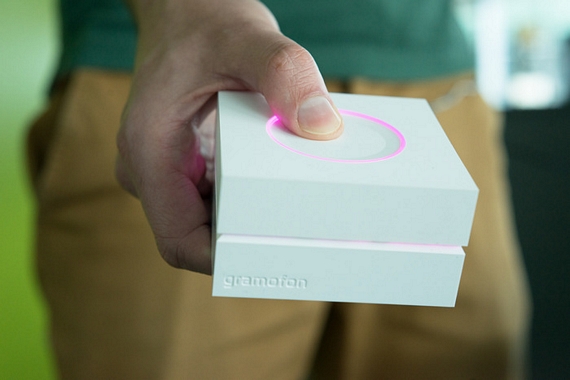
If you're not familiar with Fon, it's a company whose core business is operating a large system of crowdsourced, dual-access WiFi networks, which has grown to an impressive 13 million hotspots across Europe and North America. With that many hotspots at their disposal, the next logical step should be to create products that take advantage of them and that's exactly what the company is doing with the Gramofon.
To share your internet with Fon's network, you need to use a specialty router that runs the company's proprietary software, which dedicates part of your internet on a public network that's separate from the default network you use at home. Their new device comes with that WiFi router sharing capability, too, but adds "social music" features on top of the mix, essentially serving as a dedicated streamer for cloud-based music services like Spotify.


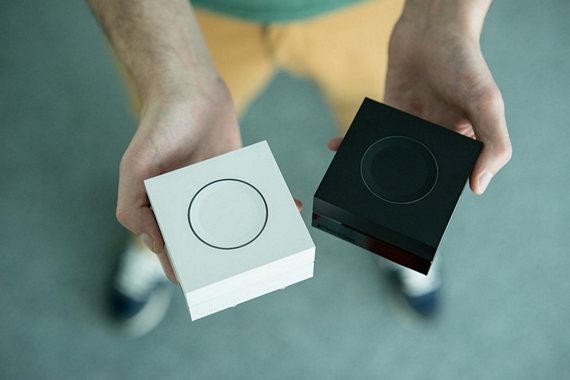
The Gramofon connects to your home system either via Ethernet or WiFi, then creates a wireless hotspot where other people can connect (via Facebook, rather than a separate WiFi password), either to access the internet or control playback on the device from their own mobile devices. There's no onboard speaker, so you'll have to hook it up to headphones, a speaker, or your home sound system via the 3.5mm line out. The device, which measures a very portable 3.14 x 3.14 x 1.65 inches, can be controlled via a button with a multi-color LED indicator on top or through a mobile app (Android and iOS).

Read more ...

Wearhaus Arc Adds Social Feature To Headphones

Wednesday, 2 July 2014
Headphones are, by their very nature, an antisocial device. After all, you use it to listen to whatever's playing all by your lonesome while tuning out all other sounds in the immediate surroundings. That doesn't mean it couldn't benefit from a slight injection of social features, though, and that's what the Wearhaus Arc does.
A pair of headphones designed for sharing, it lets you sync whatever track you're got playing to other Wearhaus Arc headphones in the vicinity. No loud Bluetooth speakers necessary to enjoy a setlist with the rest of your friends (and annoy everybody else who aren't your friends) --just sync all your headphones and listen to the same tracks in unison.


Wearhaus Arc connects using a companion app on each user's phone, allowing you to create a small network of users who can broadcast and receive tracks within the group. Not only can you share music with other users, it comes with a mic for chatting with people in the network, too, turning the entire experience of using headphones a surprisingly social affair. Connections are made over Bluetooth, with the integrated battery powering it for up to 16 hours on a single charge (although that goes down to 10 if you're the one broadcasting your music).
Read more ...

U.S. military begins testing ‘smart’ rifles

Wednesday, 2 July 2014
Tracking Point gun.jpg

“The military has purchased several units for testing and evaluation purposes,” Schauble said during an interview with Military​.com Tuesday here at the annual SHOT Show, the country’s largest gun show with some 60,000 attendees.]
It’s not hard to see why more than 30 government and law enforcement agencies have requested demonstrations of the potentially game-changing technology since the company debuted the rifle at last year’s show.
With only a few minutes of instruction on the weapon, this correspondent was able to hit a target almost 1,000 yards away on the first shot. Of the 70 or so reporters and other novice shooters who tested the weapon on Monday at a range in Boulder City, Nev., only one or two missed the target, which was located about 980 yards away, according to Schauble.
“That is a better day than usual,” he said. “I would say we’re at about 70 percent first-shot success probability at 1,000 yards … with inexperienced shooters.”
By comparison, military snipers and sharpshooters have a first-shot success rate of between 20 percent and 30 percent, said Schauble, a relative of the firm’s Chief Executive Officer Jason Schauble. They usually reach about 70 percent on subsequent shots, he said.
“That’s the big value proposition,” he said. “There’s a huge gap between first shot and second shot.”
The military testing seeks to determine how typical troops perform using the weapon compared to expert marksman using traditional rifles, Schauble said. The Army has long been excited about the promise of precision-guided, shoulder-fired weapons. Last year, it tested the XM25 air-burst weapon in Afghanistan
Read more ...

Samsung Gear Fit Smart Band

Wednesday, 2 July 2014
Samsung has quietly slashed the price of its Gear Fit fitness band to Rs. 12,100, down from theprevious price tag of Rs. 15,450.
The Samsung Gear Fit is now available with the new slashed price at the company's India e-store. As of now, there is no word whether the price cut is a limited period offer or is a permanent one.
Samsung, at MWC had announced the Gear Fit, alongside two new smartwatches the Gear 2 and Gear 2 Neo. All the three new wearable devices reached Indian markets only in April.
For those unaware, the Samsung Gear Fit is the "world's first" wearable device with a curved Super AMOLED touch display and is a fitness band. It is smaller and lighter than the Gear 2 and Gear 2 Neo smartwatches, and is focused on health. It features a 1.84-inch Super AMOLED display with a 432x128 pixel resolution. The Gear Fit comes with a pedometer, heart rate monitor, and a sleep monitor.
A 210mAh battery powers the Samsung Gear Fit, which gives a typical usage of 3 to 4 days and up to 5 days with low usage. The device measures in at 23.4x57.4x11.95 mm (body only) and weighs 27 grams.
Notably, Samsung is famous for quietly slashing prices of its devices as the company officially slashed the price of its Galaxy Note 3 Neo to Rs. 33,990 in April. This was soon followed by the Galaxy S4 andGalaxy S4 Mini, which received price cuts in May.
In April, Samsung, in an attempt to dismiss reports that claimed a possible price cut in the Galaxy S5, had to clarify by issuing an email statement to the media that said, "reports claiming Samsung Electronics has revised prices of Galaxy S5 are false and baseless" and the Galaxy S5 "continues to be priced at Rs. 51,500."
Notably, at Google I/O 2014, Samsung and LG both launched their Android Wear-based smartwatches, the Gear Live and the G Watch, respectively. The move was a surprise on the Samsung's part, as the company's recently unveiled second generation of smartwatches (Gear 2 and Gear 2 Neo), both ran Tizen instead of the Android. The company even announced an update for the first generation Galaxy Gear, to replace Android with Tizen.
Read more ...

Samsung Chromebook 2

Tuesday, 1 July 2014
Chromebooks still aren't for everyone: There will always be people who need stronger performance. Who need full offline access. Who need to install Skype. If that's you, no Chromebook will do, even if it is wrapped in fake leather. For a certain kind of customer, though -- schools, students on a budget, a traveler in need of a lighter laptop -- Chrome OS could be compelling. Those people need a sturdy keyboard for typing, but can get by doing almost everything online. If that's you, we recommend the Samsung Chromebook 2 over everything else in its class. Yes, it's pricier than its rivals, but for the money you get a sharp screen, a premium-looking design, long battery life and a keyboard-trackpad combo so good even "regular" PC makers should take note. At $400, it doesn't feel like a netbook; it feels like a proper laptop. And we dare say, it's nicer than any Windows notebook you'll find at this price. Keep that in mind the next time you're perusing the budget shelf at Best Buy.


It's easy to make fun of Samsung for its apparent leather fetish. I mean, if I wore pleather with everything, you'd laugh at me, too. But, as they say, don't knock it till you try it. Aside from the corny "stitches" lining the perimeter of the lid, the fake leather (available in gray only on the 13-inch model) actually gives the device a premium feel. That's partly because of the resemblance to real leather, but there's something else at work, too: The textured material does a good job masking fingerprints. Scratches, too. Even now that I've been using it a week, the machine still looks fresh. Not bad for a laptop that only costs $320.
Of course, your opinion might change once you flip the machine over. Whereas the lid has been done up to look like a car seat, the bottom is made of plain gray plastic. Not that there's anything wrong with that; plenty of pricier PCs are made of this stuff. It's just that the pleather and plastic look mismatched, especially since the underside is more prone to picking up finger grease. Oh well. Not a big deal -- it's not like you have to look at the bottom that often, right?
Lift the lid and the Chromebook 2 looks like other recent Samsung laptops -- save for the Chrome OS hotkeys, of course. That same gray plastic clothes the palm rest, keyboard deck and bezels, with few embellishments, except for some subtle chrome trim around the trackpad. It's not fancy, but it doesn't look cheap, either. That's the most you can ask for at this price, really.
In-hand, the Chromebook 2 is about as heavy as a 13-inch Ultrabook, which is to say it weighs around three pounds (3.06, to be precise). As a bonus, it's noticeably thinner and lighter than the Toshiba CB30 Chromebook, one of the only other 13-inch Chrome OS devices available right now. That guy comes in at 3.3 pounds and 0.8 inch thick, compared with 0.65 inch for Samsung's model.
Sometimes, though, the Chromebook 2 feels heavy for what it is: a laptop with a browser for an OS. If it can't do as much as a proper Ultrabook, it probably shouldn't weigh as much, right? The thing is, that's not really a fair comparison. For one, 13-inch Ultrabooks cost way more. In fact, you'll be hard-pressed to find a Windows laptop at this size and this price that's this well-made (or has this nice a screen). And while a tablet would weigh less, you'd be stuck with an inferior typing experience (because let's not pretend keyboard cases are the real thing). It's all about your priorities, I suppose. That said, if you're bothered by the weight here, you should look into the 11-inch Chromebook 2; that weighs 2.65 pounds.
Whichever version you get -- the 11- or 13-incher -- the selection of ports will be the same. On board, there are two USB connections (one 3.0, the other 2.0), a full-sized HDMI socket, a headphone jack, a standard lock slot and a microSD reader to complement the industry-standard 16GB of storage. Like all Chromebooks, this one comes with 100GB of Google Drive space, so perhaps local storage will be a moot point. That said, the microSD slot thing is a bit of a shame, because it means you can't insert the full-sized memory card you might be using in your standalone camera. If you've gotten used to taking shots on a phone or tablet, though, being able to swap in a microSD card could actually be a convenient setup.

I've got some good news and bad news. On one hand, the Samsung Chromebook 2 has a full HD, 1,920 x 1,080 display, making it sharper than most other Chrome OS devices (not to mention my aging MacBook Air). And that's not just me reciting the spec sheet: The screen is noticeably sharper than other 13-inch laptops, especially those you're likely to find in this price range. It's great if you're streaming movies; it's great if you want to browse photos; it's great if you want to see more of your Gmail inbox on the screen at one time. Basically, it's great all the time.
The problem is that while the pixel count has improved, the quality of the screen still has a ways to go. The LED panel doesn't make use of any wide-angle viewing technology, which means you'll have to fiddle with the screen position to get the white balance right. Tilt the display forward even a little and the colors will start to wash out, making on-screen text harder to read. (This can be an especially big challenge if you're typing with the machine in your lap.) Thankfully, viewing angles are a bit better from the sides, so you could, if you wanted, have a Netflix-viewing party with a couple friends. In any case, the viewing angles aren't much better on competing devices, so perhaps this is all a moot point.
On a positive note, the screen is brighter than on the last-gen model: 250 nits, up from 200. As it is, the screen has a near-matte, anti-glare finish that cuts down on reflections, but you'll notice even fewer artifacts if you bump up the brightness. For me, this came in handy when I was working near a window, with lots of natural light pouring in; in situations like that, I needed all the backlight I could get. Same goes if you find yourself working outside on a patio (lucky you!). My only warning -- and this goes without saying -- is that the higher brightness setting drains the battery faster. At max brightness, for instance, the battery-life tray said I had 88 percent, or three and a half hours, left. With more moderate brightness settings, an 88 percent charge would actually mean I had nearly seven hours remaining.
Read more ...